
From Clay Tablets to AI: Writing Technologies, Surveillance, and the God Complex
From Clay Tablets to AI: Jungian Psychology, Digital Panopticon, and Totalitarian Power
POLITICS
Giovanni
2/23/20262 min read
From Clay Tablets to AI: Writing Technologies, Surveillance, and the God Complex
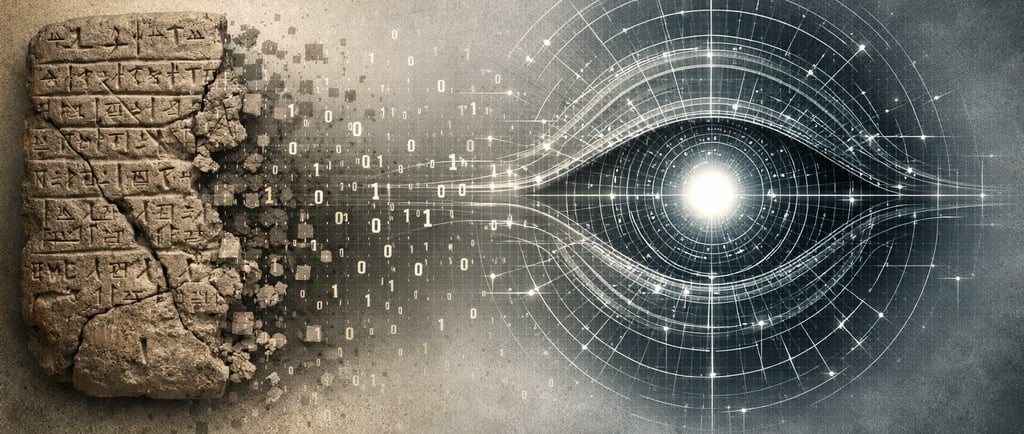
There is a direct line connecting clay tablets to artificial intelligence. The technologies change, but their psychological function does not. Each new medium reorganises consciousness, and, with it, power itself.
Jung warned that technological expansion without psychological reflection risks inflation.
“The tempo of the development of consciousness through science and technology was too rapid and left the unconscious… far behind… forcing it into a defensive position which expresses itself in a universal will to destruction.”
— Jung, The Undiscovered Self
Writing, and the first long reach of power
The moment symbols were pressed into clay or carved into stone, authority no longer depended on local memory and embodied relationship. Power could travel without the ruler’s presence. Administration began to eclipse soul.
Hillman names the bargain civilisation tends to make.
“Civilisation prefers order to imagination, control to relationship.”
— Hillman, A Terrible Love of War
Analog limits, and the psyche’s breathing room
For millennia, information systems were constrained by labour, space, and interpretation. Archives were heavy. Scribes were finite. Control required intermediaries, and intermediaries preserved gaps, distortions, and delays. In those gaps, the psyche retained some room to remain plural.
“Politics attempts to simplify what the psyche insists on keeping plural.”
— Samuels, Politics on the Couch
Broadcast, then the smooth subject
Radio, cinema, and television shifted the psychic posture of the audience. The subject did not need to respond. Reception replaced dialogue. Spectacle replaced discourse. Communication became smooth, and smoothness tends to dissolve otherness.
“The society of transparency is a society without friction, without otherness, and therefore without depth.”
— Han, The Expulsion of the Other
AI as flood, and as panopticon
AI marks a qualitative rupture because it does not only store and distribute meaning. It generates it, endlessly, at scale. Archetypally, it resembles a Flood: a rising tide of undifferentiated content that blurs origin, intention, and symbolic boundary.
“When imagination is replaced by literalism, psyche drowns in its own productions.”
— Hillman, Re-Visioning Psychology
At the same time, AI operationalises the panopticon. Bentham described an architecture of surveillance. Foucault described its internalisation. AI makes it environmental: continuous observation, prediction, and behavioural steering, without fatigue.
“He who is subjected to a field of visibility… becomes the principle of his own subjection.”
— Foucault, Discipline and Punish
The temptation of omniscience
Historically, totalitarian control struggled with logistical limits. AI removes many of them. Influence can become personalised, continuous, and automated, not only silencing voices, but overwhelming them, shaping perception through saturation.
Here the God Complex appears in its modern guise: omniscience without embodiment, judgement without relationship. The danger is not simply surveillance, but a subtle reengineering of inner life, preference, attention, imagination, until the person becomes legible, and therefore governable.
Reflection as resistance
We are living through a transformation as radical as the invention of writing itself, but at unprecedented speed. If earlier technologies extended power outward across geography, AI extends it inward, into perception, preference, and thought. The psychic task is not panic, but reflection. Without reflection, inflation tends toward destruction.
Read more on my Substack: From Clay Tablets to AI: The Birth of the Digital Panopticon
References
Jung, C. G. The Undiscovered Self (1957).
Hillman, J. A Terrible Love of War (2004); Re-Visioning Psychology (1975).
Han, B.-C. The Expulsion of the Other (2018).
Samuels, A. Politics on the Couch (2001).
Foucault, M. Discipline and Punish (1975).
Depth Psychotherapy
A journey towards your individuation.
Contact details
giovannifelice.pace@gmail.com
+447417438853
© 2025. All rights reserved.